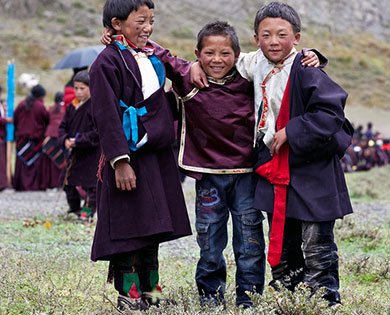
The Himalayan region of Nepal contains spectacular arrays of peaks over seven thousand meters high, including Mount Everest, the highest mountain is the world. The Sherpa people, who inhabit the rugged but beautiful valleys below, are known for their hospitality and unique Buddhist culture. The region has seen immense improvement after the arrival of trekkers and mountaineers. It now has airports, hospitals, schools and electricity. Yet there are still no drivable roads in the region. In addition, the schools are not properly staffed with experienced teachers and many Sherpa families prefer to send their children to schools in Kathmandu. Many poor families cannot afford this option.
When you volunteer in Himalayan region of Nepal, you will work to strengthen the educational system in the region and make the local children realize their full potential. The local community will also enthusiastically welcome you and your work will be greatly appreciated.
All volunteer programs start on the first and third Monday of each month.
If you are tired of expensive volunteer programs but want to make a positive contribution in the world, look no further! Global Crossroad is dedicated to offering high quality, well-organized and meaningful programs at the most affordable price in the United States. We work hard to keep costs as low as possible, focusing on the effectiveness of our projects, the safety of our volunteers and the quality of participant experiences. We currently offer the most competitive price possible in today's market including an application fee (of $299) AND a small weekly fee as follows:
| 1 Week | 2 Wks | 3 Wks | 4 Wks | 5 Wks | 6 Wks | 7 Wks | 8 Wks | 9 Wks | 10 Wks | 11 Wks | 12 Wks |
|---|---|---|---|---|---|---|---|---|---|---|---|
| $350 | $500 | $650 | $800 | $950 | $1,100 | $1,250 | $1,400 | $1,550 | $1,700 | $1,850 | $2000 |
Airport pickup, drop and first accomodation $50
Fly to Himalaya (Lukla) $330 (depends on season)
Mandatory Comprehensive Travel Insurance $3.49/day
Language and Culture Program fee $250
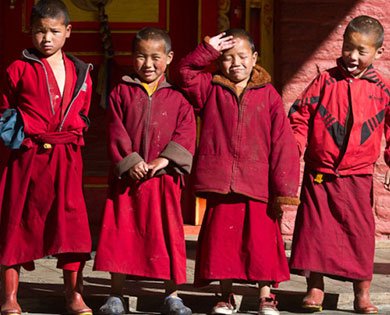
People from the Sherpa community become monks at a young age and they gain a deep knowledge of scriptures and meditation while at the monastery. At present, English is not in the curriculum but the monastery has now realized the importance of the subject to their young monks. Learning English will allow the monks to work as guides or to start their own business later in life. Those who prefer to stay on as a monk can use their English language skills to communicate effectively with outsiders and help their monastery. Currently, there are no resident English teachers and volunteers are in great demand. While volunteering, you can also witness colorful rituals inside the monastery and participate in meditation and other ceremonies.
Monk Teaching is not available from the Last week of December to First week of March
As a volunteer in Nepal teaching English to Buddhist monks in a monastery, you will primarily work as English instructors to the monks. You’ll teach English to monks for 2-4 hours a day. You are encouraged to hold discussions and debates as this will greatly increase the ability grasp and speak English. Daily activities may include:
Note: in addition to teaching, you’ll also be allowed to sit, observe and learn about the rituals, prayer ceremonies and meditations inside the monastery and learn about Buddhism from the monks.
No teaching experience or skills are required, but each volunteer in the teaching English to Buddhist monks project in Nepal should have strong English skills, both written and verbal. You should also respect the monks at all times as well as the prevailing culture inside and outside the monastery.
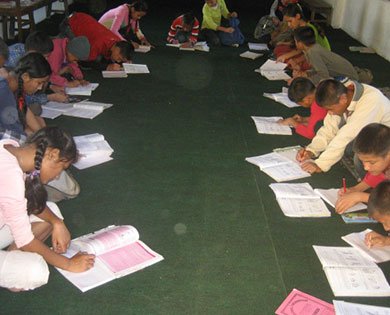
The schools in the Everest region, like anywhere in Nepal, want their students to be able to speak and write English. But many fail to do so. English is one of the hardest subjects for students and many regularly fail. The reasons for this are manifold. Firstly, English is taught in Nepali. The teachers do not speak to their students in English, or very few do, and secondly, the students are taught to memorize words and phrases, rather than understand the language. The students do not practice speaking English with anyone else. What they learn in the classroom stays in the classroom. In this environment, an international volunteer who speaks only in English will help the kids immensely. You will not only encourage students to speak in English, you will also help them to comprehend the language. Our experience shows this will instill confidence in the students and motivate them to learn even more. While working, you will find the teachers and the parents extremely appreciative of your effort and you will go home with life changing experiences and memories.
School teaching project is not available from last week of December to first week of February
The school is also be closed during Dasai and Tihar holidays (usually in October)
As a volunteer teaching English in Nepal, you will most likely teach in a government school. Besides following the official curriculum, you’re encouraged to hold debates and discussions as well as engage the children in creative activities that will increase their capacity to comprehend and speak in English. Daily activities may include:
*if school is closed, volunteers will work in orphnages
You should be fluent in English, both spoken and written, although you may be a non-native English speaker. You should also have a passion to teach and help your students. Volunteers should be good role models, flexible, patient, caring, creative, responsible and open-minded.
Global Crossroad Volunteer arranges volunteer meals, accommodations and strong field supervision for the duration of projects and optional travel packages. In Nepal, most volunteers stay with a host family. Host family accommodations are simple and clean homes in safe neighborhoods. Volunteers usually have a private bedroom, but occasionally rooms will be shared with a same-gender volunteer. Our host families are well screened and are respected members of their communities who live in affluent neighborhoods. Most of our host families have experience with hosting international volunteers. Host family stays are a great chance for cultural immersion and exchange.
Accommodations could also be with a home base or a hostel. Our home base is a permanent home established for our volunteers in Kathmandu. Our home base in Nepal is located in a very safe and clean neighborhood. There are internet cafés, restaurants, local bus stations, a police station and supermarkets near our home base. The home base provides a comfortable place to relax after a long day. There are several bedrooms (which may be shared with a same-gender volunteer) and community areas. There is a shared kitchen, television and shared bathrooms, which have running water and "western-style" toilets. Hostels are located in safe and secure neighborhoods and are chosen for their proximity to projects.
Volunteers receive three local meals per day (breakfast, lunch and dinner). We can provide vegetarian meal options, but needs must be detailed in a volunteer's application. Snacks and beverages outside of mealtimes are not provided; however, there are local restaurants and grocery stores near the residences in which we place volunteers.
Global Crossroad offers unparalleled field support to volunteers to ensure a safe and rewarding experience. There are many layers of support for you. The most important support comes from our country coordinator/field staff. The secondary support comes from the host project staff and members of host families and/or a home base staff. Volunteers will have access to our country coordinator's mobile number and they are available 24/7. Throughout the volunteer project, our local staff stays in contact with volunteers either with face-to-face visits or via email/telephone. Our field staff will visit regularly (every 2-4 weeks) to make sure things are going well and as planned. However, if placement is far from our local offices, staff members will stay in touch via email/ phone. Volunteers are also welcome to stop in the offices at any time.
Specific details regarding accommodations, food and contact details for our local coordinator will be provided in personalized volunteer placement documentation prior to arrival.
Global Crossroad Volunteer projects are available in Kathmandu (capital city of Nepal with places of great tourist attractions like Thamel, Patan, Swaymbhu, etc.), and Pokhara (a small valley that is famous for lakes, spectacular views of Himalayas and for a starting point of many famous treks). Both the towns have shops, banks & internet cafes nearby. Nepal is renowned for its spectacular landscape and deep, exotic culture. It's full of contrasts: from traditional culture and history including houses made of bamboo, mud and cow-dung to modern infrastructure and much of the amenities you would expect from a city.
Please read Global Crossroad Volunteer's 5-step application
Arrival Point: Tribhuvan Airport , Kathmandu
Airport Pick-up Upon the receipt of your flight information, our in-country coordinator or other project staff will greet the volunteers in the airport and take you to your project site. The address and telephone number of the local contact hotel will be given before departure just in case volunteers miss our representative in the airport. Please make sure to e-mail your flight information to both the USA office and the local in-country coordinator's office.
Departure Point: Tribhuvan Airport , Kathmandu
Airport Drop: Rarely, a few do request an escort back to the airport; this is an extra expense of about $75. Most are very familiar and comfortable with their stay and have great ease taking their own taxi or bus back to the airport.
Transportation: Global Crossroad Volunteer manages one-way transportation to project. Volunteers will be responsible for their own personal and return travel. We do not cover daily transportation from host family/hotel to the project. Our program is designed to save you the volunteer as much as possible.
Start Dates: 1st and 3rd Monday of each month
Start Date: Global Crossroad Volunteers/Travelers coming to Nepal Himalaya are advised to arrive one day before their program start date. If you arrive more than one day early or stay after the program, you will be responsible for your room and food expenses.
Working Hours: 30- 40 hours per week
Global Crossroad strongly suggest that all volunteers apply for a tourist visa in a timely manner before departing for Nepal Himalaya. Please call our office or contact the local Nepal Himalaya embassy to learn more about visas, visa fees, and visa extensions. Getting your tourist visa is your responsibility.
Volunteers should be aware of all health and safety information before traveling to Nepal Himalaya. We suggest you visit some of the websites listed below.
General Health Tips for volunteer/travel in Nepal Himalaya
Bring drugs you require with you. Although you can find most modern medicines in the drugstores of Nepal Himalaya, they can be named differently and come with different level of dosage. Carry a health kit and include medications for upset stomachs, some antiseptic cream, mosquito repellant, sun block, band aids, etc.
We use the Center for Disease Control traveler's health recommendations (www.cdc.gov.) Your travel doctor will know about current epidemics and should be consulted.
The following vaccines may be recommended for your travel to South Asia including Nepal Himalaya.
Nepal Himalayaese Rupees is the local currency of Nepal Himalaya.
You can change your money upon arrival to Kathmandu's Tribhuvan International Airport. There is a bank counter at the departure lounge and three bank counters at the arrival lounge. All transactions are based on the declared amount of the passenger and the currencies permitted by the government, depending on the day's foreign exchange rate. We suggest you change $200 in the beginning as you can change money in any bank (some banks are near our office).
Your credit card information can be stolen and used fraudulently just by making a credit card payment. For this reason, cash and travelers checks are suggested to settle most accounts. You will have trouble paying with traveler's checks, but you will be able to exchange them at local banks. Traveler's checks are recommended as a safe way to carry money with you, make sure you write down the check numbers and contact information you need to cancel stolen checks. Different brands of traveler's checks work better in different countries so consult your local financial institution about which company you should buy your checks from.
Travelers should have a credit card for large and emergency purchases so you won't go broke if something goes wrong. If you've requested a pin number for your credit card, you can use it to get cash advances at the ATM.
You can also carry a debit card that can be used at ATM's to withdraw local currency. When using ATM's, be advised to bring a friend along, travel directly from the bank back to your home and stash your cash. Find a private, well-disguised place to hide any cash. When you are carrying cash, break it up into different amounts and keep it in different pockets so if you get robbed you won't lose everything.
Debit cards are the best way of getting money and ATM vendors are available in major bank and department store in Kathmandu. Visa, MasterCard and American Express are accepted in some of the large stores and hotels in larger cities but not accepted in smaller cities.
How much money you bring depends on your personal spending habits. Thrifty people can get by on less than $10/day. Your budget should also include money to explore Nepal Himalaya in free time as well as for your personal use. A good rule of thumb for money management is the 1/3 method, bring 1/3 cash, 1/3 traveler's check and leave 1/3 of your money in your account - plus a credit card for emergencies.
Field Support and supervision:
Our local staff (and country coordinator) will keep in touch with your once the program stays. We will also visit you every 2 weeks to make sure you are happy and satisfied with the project. If the project is very far, then our local staff members maintain communication by email and phone.
You'll also be provided with the mobile phone number our country coordinator. In case of any emergency, you can contact him directly.

Bring your mobile cell phone with you. When you're in Nepal Himalaya, insert the local sim card and you'll be ready to receive or call anyone anywhere in the world. Internet cafes are widely available in Kathmandu and Chitwan.
Take advantage of the Web which can bring you current weather and forecasts for your destination:
http://www.wunderground.com/global/stations/44454.html(www.wunderground.com)
Nepal Himalaya has a diverse climate; summer is normally the hot, humid and rainy season. Winter is cold in the morning and warm during the daytime. The temperature drops during winter nights. Volunteers should bring appropriate clothing according to the season and activities. The months of fall and spring are wonderful.
Month
Sept
For working: Feb Winter clothes
For Trekking: Winter Clothes
March
For working: August Summer Clothes
For Trekking: Warm (light winter) Clothes
*Please bring a raincoat in June-July-August
Most of daily use items are available in Nepal Himalaya at a cheaper price. However, we suggest volunteers pack the following things:
It is a common courtesy to bring a small gift for the family that will be hosting you. You are not required to do so, but if you choose to bring something it can be pretty simple. We suggest a box of chocolates, a t-shirt with a hometown logo or pictures of your family and some local post cards.
If you want to bring gifts for your project (and if you are working for an orphanage or a school please bring pencils, pens and paper, art supplies like markers and construction paper pads, and games. Remember that every child will need these items so you may wish to bring a bunch of one thing.